

Memory enables agents to maintain state and context across conversations. With memory configured, agents remember previous interactions and can resume conversations after failures or restarts. Idun Agent Platform supports multiple memory and checkpointing strategies depending on your agent framework.Documentation Index
Fetch the complete documentation index at: https://docs.idunplatform.com/llms.txt
Use this file to discover all available pages before exploring further.
Framework support
How checkpointing works
Checkpointing saves your agent’s state during execution. Each interaction is associated with a unique session or thread identifier, and the platform saves state snapshots at each step of the agent graph. This enables:- Conversation continuity: Maintain context between interactions
- Fault tolerance: Resume from the last successful step after a failure
- Thread isolation: Each
session_idmaps to a unique thread, keeping conversations separate - Concurrent conversations: Multiple users can interact with the same agent simultaneously
Backend comparison
| Backend | Persistence | Concurrency | Best for |
|---|---|---|---|
| In-memory | None (lost on restart) | Single process | Development and testing |
| SQLite | File-based | Single writer | Local development, single-instance deployments |
| PostgreSQL | Database | Multi-process | Production, multi-instance deployments |
| Vertex AI | Cloud-native | Distributed | Production on Google Cloud (ADK only) |
| Database (SQL) | SQL-based | Multi-process | Production with SQL persistence (ADK only) |
Quick configuration examples
- Manager UI
- Config file
Browse the backend catalog
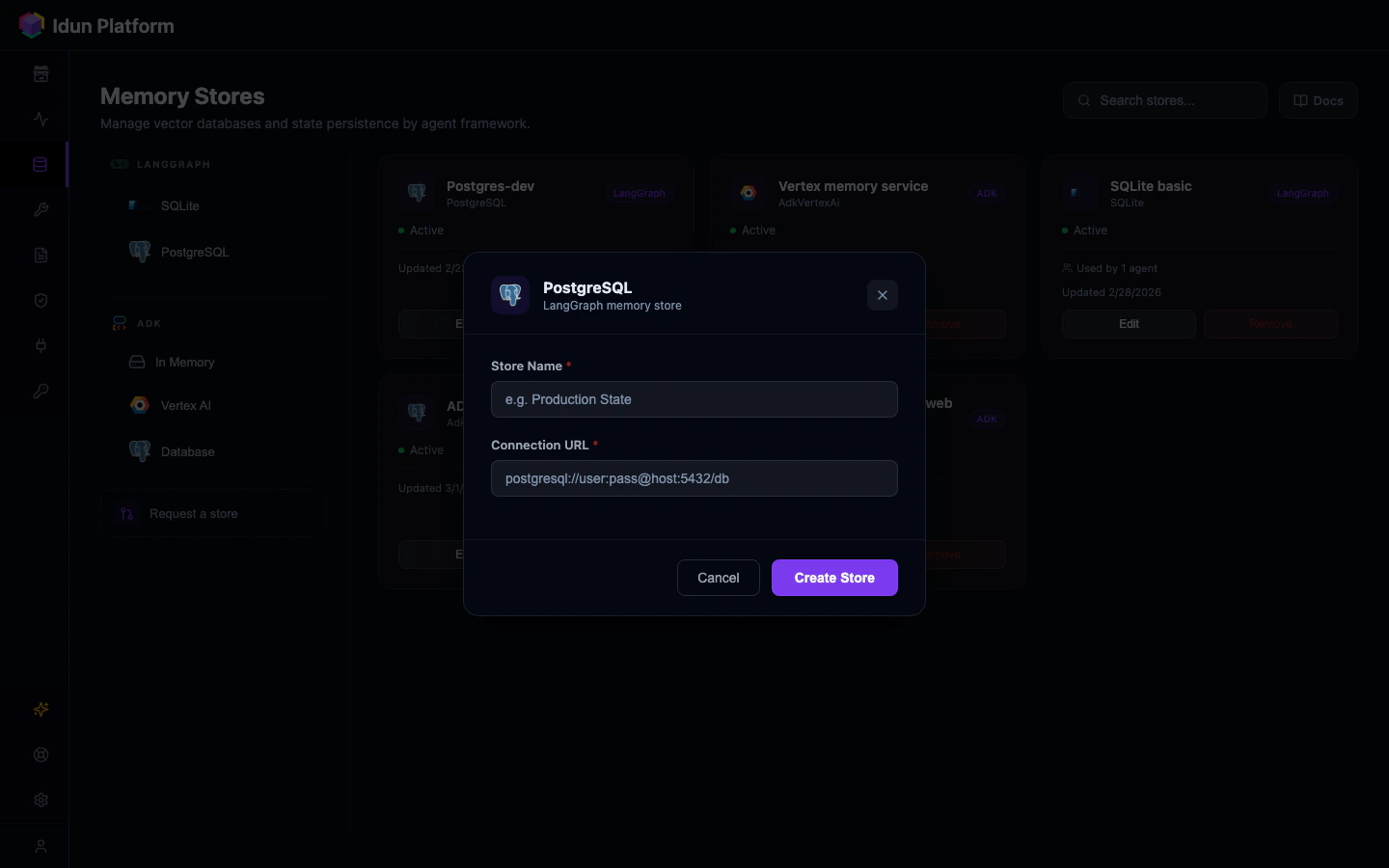
Navigate to Memory Stores in the sidebar. The catalog shows backend cards: SQLite, PostgreSQL, In Memory, Vertex AI, and Database.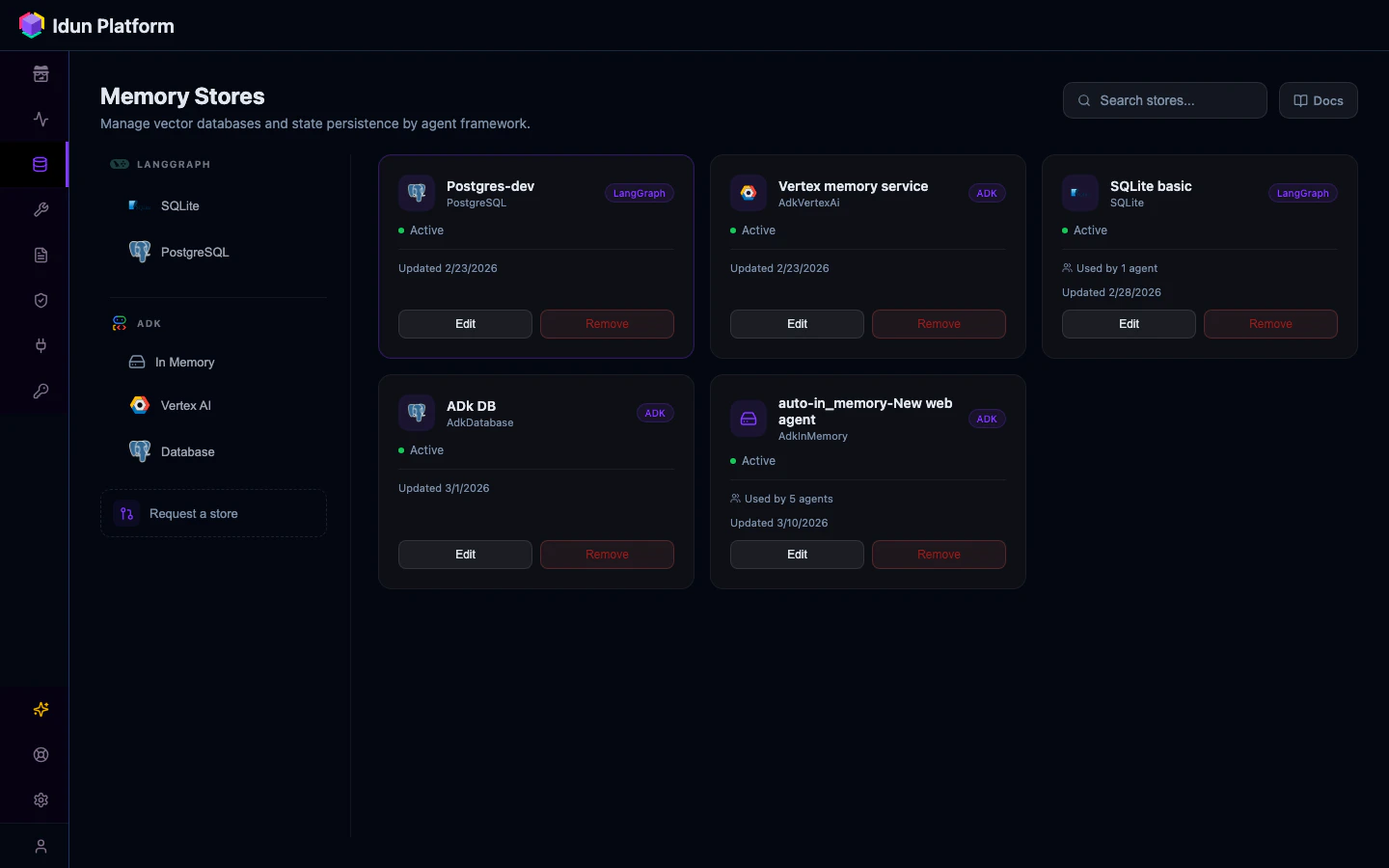
Best practices
- Use in-memory for development: No setup required, fastest iteration
- Use PostgreSQL or Database for production: Multi-process support, reliability, and crash recovery
- Configure thread isolation: Each conversation should have a unique
session_idto prevent state leakage - Monitor storage usage: Long-running conversations can accumulate significant state over time